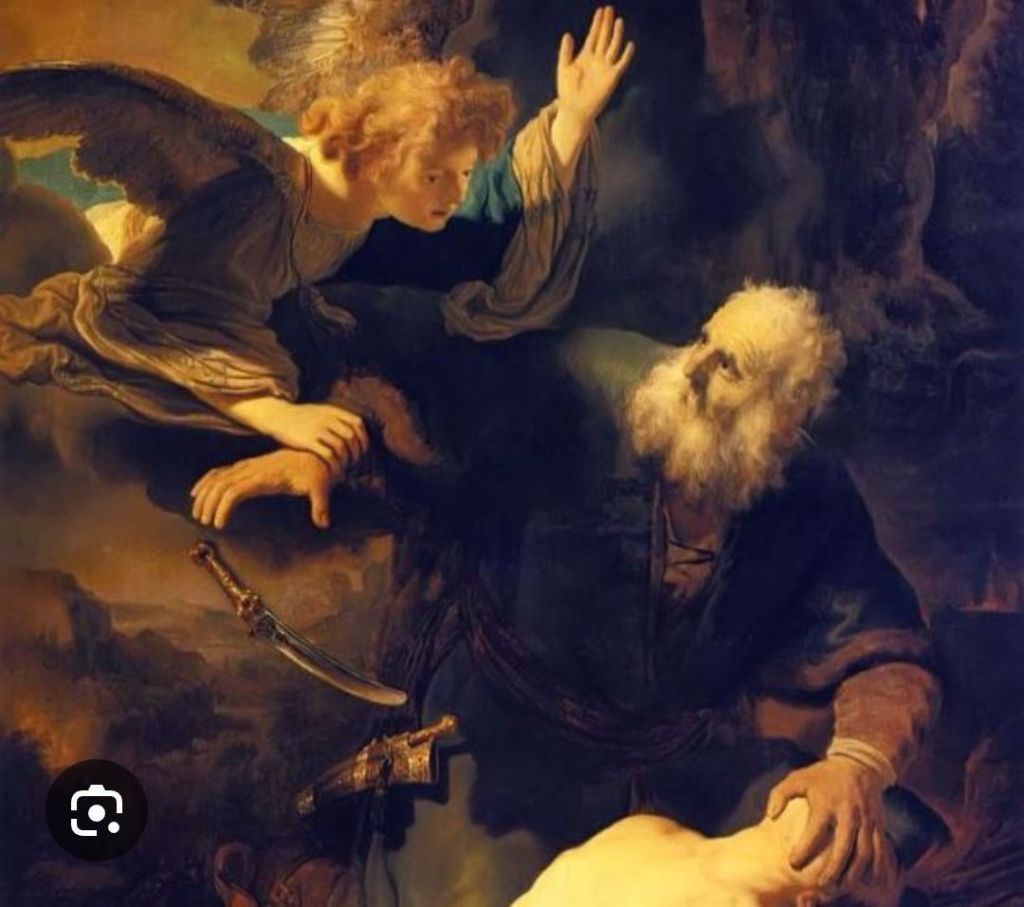
Today, I read Torah for the Second Day of Rosh Hashanah, probably one of the most dramatic lines in all of Torah from the famous “Akedah,” or Abraham’s near sacrific of his son, Isaac on Mount Moriah.
There’s some deliberate dramatic embellishment that use. (Genesis 22:11)
וַיִּקְרָ֨א אֵלָ֜יו מַלְאַ֤ךְ יְהוָה֙ מִן־הַשָּׁמַ֔יִם וַיֹּ֖אמֶר אַבְרָהָ֣ם ׀ אַבְרָהָ֑ם וַיֹּ֖אמֶר הִנֵּֽנִי: (בראשית פרק כב פסוק יא)
“And he (someone, its not immediately clear who, but one assumes it’s meant to be God) (through an) angel of God from the heavens and he (the angel) said to him, Avraham…AVRAHAM (!!) and he (Abraham) said, “I’m here.”
Abraham is commanded by God to take his son (Isaac) up on to Mount Moriah and to sacrifice him there. It’s not Abraham’s only son, because, of course, he has another son through his maidservant Hagar, named Ishmael. But it’s clear that Isaac is his favored son. (We’ll leave Ishmael aside for right now.)
Abraham has the knife in his hand and literally, you can imagine him just about to bring it down on the neck of his son Isaac to sacrifice his son. And God stops him…

In the trope (musical cantillation for chanting Torah) you will find a kind of peculiar marking:
אַבְרָהָ֣ם ׀ אַבְרָהָ֑ם
Abraham…ABRAHAM!!! (What are tou doing…STOP!!!)
That interesting vertical line between the identical repetitions of the name Abraham (אַבְרָהָ֣ם) is called a “psik” which I interpret to be almost a literal breath between the two words. And so, I chant it that way. I chant the first repetition of the name אַבְרָהָ֣ם and then I take a deliberate pause, and then I read the second repetition of אַבְרָהָ֣ם as “ABRAHAM!” to highlight the drama in the scene. (Abraham, what are you doing? Or maybe better still, DON’T DO THIS!)
Abraham eventually discovers a ram that is caught in the thicket (miraculously?) by his horns and then sacrifices the ram in place of Isaac. Isaac and Abraham go down from the mountain. And as far as we can tell, never talk again.
Isaac and Abraham go down from the mountain. And as far as we can tell, never talk again. Wow! Talk about some pretty intense psychological drama! Another interesting actor that’s completely missing in this story is Abraham’s wife, Sarah. But we’ll leave that for another interpretation.
Of course, there’s nowhere in the translation of the text that really indicates this other than my dramatic interpretation of the story. But it’s one of the things that I really, really like about reading this particular portion on the Sexond Day of Rosh Hashanah.
So next year, when we come around to this portion again, take a listen and see if you can feel and hear the drama.
 The Tao of Steve